
What to Expect on a Komodo Liveaboard Trip
Thinking about a Komodo liveaboard trip? Here's everything you need to know — from sleeping on a traditional pinisi boat, to dragons, Pink Beach, manta rays, and nights under a sky full of stars.
Pusaka Timur Tour
5/13/20267 min read
Introduction
A Komodo liveaboard trip is one of those travel experiences that is genuinely difficult to describe to someone who hasn't done it. You sleep on a traditional wooden boat called a pinisi, wake up anchored in the middle of the national park, and spend your days moving between some of the most spectacular islands, beaches, and dive sites in Southeast Asia.
No hotel check-ins. No traffic. No rushing. Just the boat, the sea, and Komodo National Park stretching out around you.
If you are considering a liveaboard trip from Labuan Bajo and want to know exactly what to expect — this guide covers everything.
The Most Important Thing to Know Before You Read Further
A Komodo liveaboard is not a rushed trip. It is not a checklist of attractions to tick off one by one.
It is slow. Intentionally slow. You move when the boat moves, you stop when something beautiful appears, and you spend your days in a rhythm that most people have completely forgotten in their normal lives.
What happens in that slowness is where the real value of this trip lives. Hiking up to the Padar Island viewpoint with people you've only just met — and arriving at the top together, out of breath and laughing. Floating in silence above a coral reef, watching a sea turtle glide past below you. Sitting around the dinner table on deck as the last light disappears and the conversation goes places it never goes at home.
And then the nights.
When the engine is off and the boat is anchored in a quiet bay, far from any city, the sky above Komodo is something that stops people mid-sentence. No light pollution. No noise. Just a sky so full of stars it looks almost unreal — the kind of sky that most people living in cities have never actually seen.
These are the moments that become memories. Not the photos, not the itinerary — the moments between the moments, shared with the people you brought with you, or with the strangers who become friends somewhere between the first snorkel and the last sunset.
That is what a Komodo liveaboard really is.
What Is a Komodo Liveaboard?
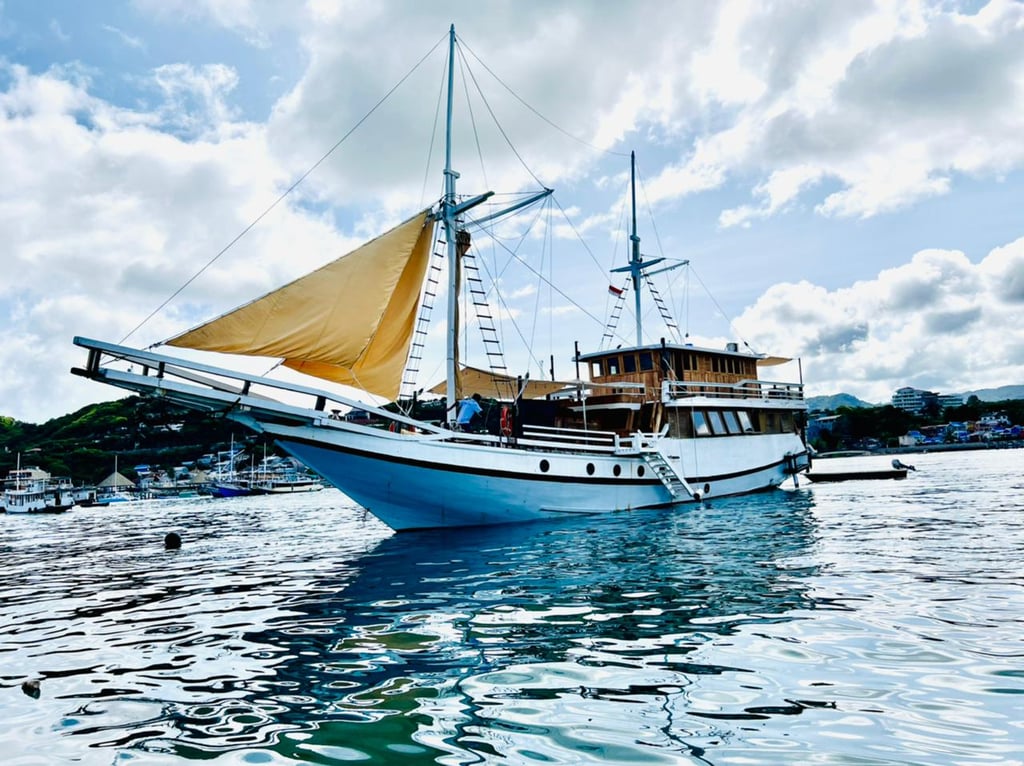
A liveaboard is a multi-day trip where you live on the boat for the duration of your journey. In the context of Komodo, this typically means a 2-night, 3-day or 3-night, 4-day sailing trip aboard a traditional Indonesian pinisi wooden boat.
The boat becomes your accommodation, your transport, and your base for exploring the national park. You anchor in different locations each night — sometimes in quiet bays, sometimes near islands you will visit the following morning.
It is the most immersive way to experience Komodo National Park, and for many travelers, it becomes the highlight of their entire time in Indonesia.
The Boat: What a Phinisi Looks Like
A traditional pinisi is a two-masted wooden sailing vessel that has been built in Indonesia for centuries. The ones used for liveaboard trips have been converted and fitted for comfort — typically with sleeping cabins below deck, a dining area, an open upper deck for relaxing and watching sunsets, and bathroom facilities on board.
Cabin sizes and comfort levels vary depending on the boat you choose. Some boats are more basic and suited to budget travelers; others are fitted with air conditioning, private bathrooms, and more comfortable bedding. When booking, always ask for photos of the actual boat and the cabin you will be sleeping in.
The sound of the boat moving through the water at night, with stars overhead and no city lights in any direction, is something guests talk about long after the trip ends.
A Typical Day on a Komodo Liveaboard
No two days are exactly the same, but here is what a typical day looks like:
Early morning, before most people are awake, the boat moves to the first location of the day. You often wake up already anchored in a new spot — sometimes with a view of Padar Island's ridgeline, sometimes next to a beach you've never heard of.
Breakfast is served on board, usually a simple Indonesian or Western-style meal prepared by the boat crew.
The morning activity varies by day but typically includes one or more of the following: hiking (Padar Island is usually included), snorkeling at a reef, visiting Komodo Island or Rinca Island to see the dragons, or exploring a beach.
Lunch is served back on the boat, followed by time to rest, swim, or simply sit on the upper deck.
The afternoon brings more snorkeling or island stops, and the day ends with the boat anchored somewhere scenic for sunset — often with a view that makes everyone stop what they are doing and just watch.
Dinner is served as the sun goes down. The evenings are quiet. Some guests read, some talk, some fall asleep watching the stars from the upper deck.
What You Will See and Do
Padar Island
Almost every liveaboard itinerary includes the Padar Island hike. The trail to the viewpoint takes 20 to 40 minutes and rewards you with one of the most photographed views in Indonesia — three bays in three different shades of blue. Schedule permitting, the boat usually arrives early morning to beat the heat and the crowds from day trip boats.
Komodo Island and Rinca Island
A visit to either Komodo Island or Rinca Island — or both — is the centerpiece of the trip. Here you will encounter Komodo dragons in their natural habitat, accompanied by a licensed ranger. These are the largest lizards on earth, and seeing them up close in the wild is an experience unlike anything else.
Pink Beach
One of the only pink sand beaches in Indonesia. The color comes from red coral fragments that mix naturally with the white sand. The snorkeling just offshore is excellent, and the beach itself is one of the most photographed spots in the national park.
Snorkeling Spots
Komodo National Park contains some of the richest marine biodiversity on earth. Depending on your itinerary and the season, snorkeling stops may include Manta Point — where manta rays are commonly seen gliding through the water — as well as coral gardens full of color, sea turtles, reef sharks, and schools of fish that most snorkelers have never seen anything like.
The water temperature is warm, the visibility is generally excellent during dry season, and most sites are calm enough for swimmers of all levels.
Kalong Island
Many liveaboard itineraries include a late afternoon visit to Kalong Island, where thousands of flying foxes — giant fruit bats with wingspans of up to one meter — emerge from the trees at dusk and fill the sky above the water. It is one of those natural spectacles that photographs cannot fully capture.
Sleeping on the Boat
The sleeping experience varies significantly between boats. On budget boats, cabins are small and ventilation is basic. On mid-range and premium boats, cabins are more comfortable, often air-conditioned, with proper beds and private or shared bathrooms.
What every boat shares is the experience of falling asleep to the sound of water, the gentle rocking of the boat, and complete silence from the outside world. Guests who expected to struggle with the conditions often find it is one of the best sleeps they've had in months.
A few practical notes: bring earplugs if you are a light sleeper, as the boat engine starts early. The bathroom situation on budget boats is basic — if this matters to you, invest in a better boat.
Motion Sickness
This is the question we hear most often. The honest answer: it depends on the sea conditions and your sensitivity.
During dry season (April to October), the seas around Komodo are generally calm. Most guests have no issues. If you are prone to motion sickness, take medication the evening before departure and again in the morning of the first day. Sea bands (acupressure wristbands) also help many people.
If conditions are rough — which is more likely outside of dry season — the crossing between certain islands can be uncomfortable. Sailing at night helps because you are asleep through the movement.
If you are unsure about your sensitivity, a 2-night trip is a safer starting point than a longer one.
What to Pack for a Komodo Liveaboard
Reef-safe sunscreen — regular sunscreen damages coral and is not permitted in the national park
Rash guard or sun protective swimwear
Hat with a wide brim
Comfortable sandals and one pair of closed shoes for hiking
Light, breathable clothing
Motion sickness medication if needed
Dry bag for your phone and camera
Underwater camera or GoPro if you have one
Cash for the national park entrance fee and any additional purchases
Reusable water bottle — boats provide drinking water
The National Park Entrance Fee
This is separate from the cost of the boat trip and is paid on arrival. The fee varies depending on nationality and the current park authority pricing. Ask your operator for the current rate before you travel so there are no surprises. At Pusaka Timur Tour, we always inform guests of the current entrance fee in advance.
Best Time for a Komodo Liveaboard
The dry season — April through October — is the best time. Calm seas, clear skies, and excellent snorkeling visibility. July, August, and September are peak months with the best conditions overall.
Manta rays are present throughout the year but are most reliably seen between April and November at Manta Point.
The wet season (November to March) brings rougher seas and reduced visibility. It is still possible to do a liveaboard during this period, but the experience is more variable.
Is a Liveaboard Right for You?
A liveaboard is ideal if you want maximum time inside the national park, want to reach spots that day trip boats cannot reach, enjoy being on the water, and are happy with a simpler, more adventurous style of travel.
It may not be right for you if you need consistent air conditioning and comfort, have significant motion sickness concerns, or are traveling with very young children who need reliable sleeping conditions.
For families with children aged 7 and above, liveaboards generally work very well — kids tend to love the boat life, the snorkeling, and the dragons.
Booking Your Komodo Liveaboard
At Pusaka Timur Tour, we offer liveaboard sailing trips aboard traditional pinisi boats from Labuan Bajo. Our trips cover all the main highlights of Komodo National Park including Padar Island, Komodo Island, Pink Beach, and the best snorkeling spots in the area.
We offer both open trip (shared) and private charter options depending on your group size and preference.
If you have questions about which option is right for your group, feel free to reach out — we are happy to help you plan the right trip.
Visit pusakatimurtour.com for more information.
Written by Pusaka Timur Tour — Local Tour Operator in Labuan Bajo, Flores
Contact Us
pusakatimurr@gmail.com
+62 895-2386-4694
Jln. Bidadari. Depan Puskesmas Samping Bakso Labuan Bajo, Flores, Indonesia
📍
✉️
📞
Follow Us
Payment Patners



















© 2026 Pusaka Timur Tour • Licensed Komodo Tour Operator • Made with passion in Flores, Indonesia
Red Note : Komodo旅行笔记